Explanatory
The Colorado River provides drinking water to 40 million Americans and irrigates 5.5 million acres of farmland in the Mountain West. Due to increased human involvement and altered weather patterns the river system can not supply the necessary stakeholders—threatening cities, dams and natural ecosystems.
Lake Powell has been an indicator of water supply and demand patterns of the Upper Basin region of the Colorado River. The U.S. Bureau of Reclamation reported that the April–July 2026 inflow forecast for Lake Powell is 22% of average, in its April 17, 2026, Most Probable 24-Month Study.
“What's interesting this year is that we are rapidly approaching dead pool and power pool,” said Anna Penner, a Utah environmentalist with the Glen Canyon Institute.
Lake Powell, formed by the Glen Canyon Dam, distributes water between the Upper and Lower Basins of the Colorado River Basin. Colorado, Utah, Wyoming and New Mexico are the primary stakeholders in the Upper Basin watershed. The Lower Basin is made up of California, Arizona, Nevada and Mexico.
Power pool for Lake Powell is when water levels drop below the hydroelectric water outlet tunnels, effectively drying out the river downstream.
“If Glen Canyon Dam declines below 3,490 feet, water releases would be only through the river outlet works, which could cause operational issues, uncertainty for users, downstream impacts, instability in regional power and water supplies and a reduction in power generation,” the bureau said in the April 2026 report.
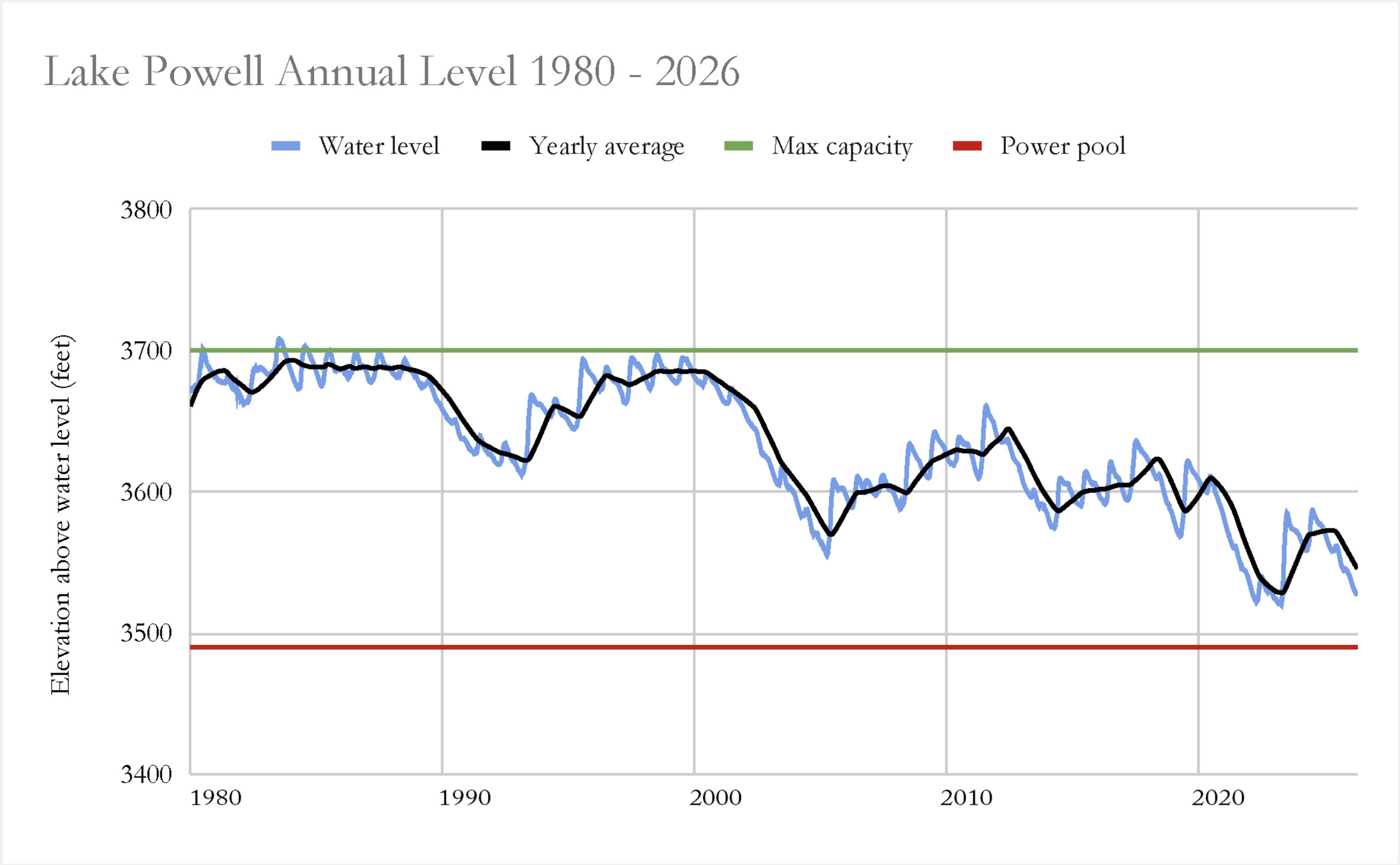
Data Credit of U.S. Bureau of Reclamation - Accessed April 22, 2026
Historical wet hydrologic conditions encouraged water intensive development of the river basin.
Mike Dehoff is the principal investigator for the Returning Rapids Project and a Moab, Utah resident. “There was just this attitude of manifest destiny of we’re taking this we’re doing this. And not one of communication, evaluation and longevity,” Dehoff said when referencing the construction of the Glen Canyon Dam and using the surrounding water.
The most recent data from the Bureau of Reclamation in 2020 found 16.4% of the water used is transported outside of the river basin to outside cities.
Salt Lake City, Utah and Denver, Colorado consume water exported from the Colorado River Basin to supplement their municipal water needs. Historically the river was able to meet and surpass the needs of the cities.
Development and demand on the watershed has increased while hydrologic conditions have decreased leading to past water allocations being challenged.
“As a Denver resident I think it is vital that my water supply remains secure and protected,” Logan Hunt, a sophomore business student at the University of Colorado said. “I love recreating outdoors so I feel a strong connection to the river and Colorado ecosystems as many others do.”
A 2025 Colorado River Roundtable survey found 74% of water used is for irrigated agriculture.
“Cattle feed crops including alfalfa and other grass hays account for 46% of all direct water consumption” Brian Richter and others said in the 2024 Communications Earth & Environment journal.
“Water requirements for alfalfa are 18 to 36 inches of water per season,” James Bauder, a researcher with Washington State University said in 1978.
Brad Udall and others at the Colorado Water Institute found 863,000 acres of alfalfa being farmed in the Colorado River Basin in a 2017 study.
One type of crop alone requires more than 1.29 million acre feet (maf) of water annually.
“The 2026 April through July unregulated inflow forecast for Lake Powell is 1.40 maf,” the bureau said in the April 2026 report.
Current spring runoff conditions will lead to decisions being made on how to fill legal obligations of water rights and fair distribution for all stakeholders.
Source list:
Anna Penner: anna@glencanyon.org
Mike Dehoff: mike@returningrapids.com
Logan Hunt: lohu7231@colorado.edu